The way a single cell behaves under charge and discharge sets the ceiling for what an entire energy storage installation can achieve. While system integrators rightly focus on thermal management, power conversion, and control software, none of those layers can compensate for limitations baked into the cell itself. At HiTHIUM, we design our energy storage battery cells with the understanding that every material choice, structural decision, and manufacturing tolerance ripples upward into metrics that matter: round-trip efficiency, usable capacity over time, and operational stability across diverse environments. This article examines how specific cell design attributes—from material chemistry to physical architecture—directly translate into the performance characteristics that define a reliable hithium battery system.
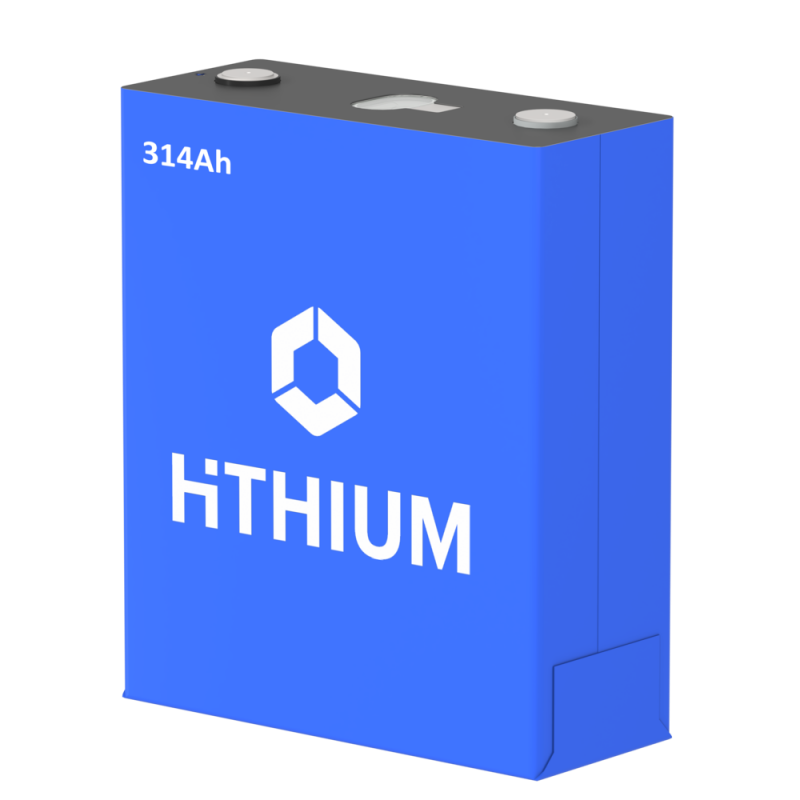
The electrochemical couple chosen for a cell determines its fundamental voltage profile, energy density ceiling, and degradation trajectory. For stationary storage applications where safety and longevity outweigh the need for extreme gravimetric density, lithium iron phosphate chemistry provides distinct advantages. Our ∞Cell 1300Ah employs this LFP material system, delivering a weight energy density of ≥190 Wh/kg alongside a volumetric capacity density of ≥406 Wh/L. These parameters mean that a single energy storage battery module can pack substantial capacity without demanding excessive floor space or structural reinforcement—a practical concern that directly influences system-level installation economics.
Material selection extends beyond the cathode to the anode and electrolyte formulation. The ∞Cell N162Ah utilizes an NFPP/HC material configuration that pushes cycle life to ≥20,000 cycles while maintaining stability across a -40 to 60°C operating window. When a hithium battery cell tolerates such extreme temperatures without accelerated degradation, the system designer gains flexibility in siting decisions and can reduce auxiliary thermal management loads, which in turn lowers parasitic energy consumption and improves net system efficiency.
What happens inside a cell during high-rate operation is governed as much by physical geometry as by chemistry. Current density distribution, heat generation patterns, and mechanical stress concentrations all trace back to electrode and cell architecture. Our approach includes an all-tab laminated stacking process that yields electrode interfaces with minimal uneven stress compared to traditional wound cores. This manufacturing precision translates into cell-to-cell consistency—a variable that cascades into pack-level imbalances if left unaddressed. In any multi-cell energy storage battery configuration, the weakest cell dictates the usable capacity of the entire string, making consistency a direct contributor to realized system performance.
The ∞Cell 1300Ah further addresses longevity through cell architecture that supports 8-hour deep cycling with a projected service life exceeding 25 years. Extended deep-cycle capability means the hithium battery system can participate in applications requiring sustained discharge, from peak shaving to renewable firming, without the accelerated capacity fade that plagues cells optimized primarily for shallow-cycling telecom backup duties.
Design parameters expressed on specification sheets gain credibility only when matched by real-world durability evidence. Our cells carry certification across multiple standards—IEC 62619, UL 9540A, UL 1973, GB/T 36276, and UN 38.3—each representing a battery of tests that probe thermal stability, mechanical integrity, and electrical safety under fault conditions. These certifications are not merely administrative checkboxes; they validate that the separator coatings, venting mechanisms, and current interrupt features engineered into the cell perform as intended when challenged.
The wide temperature tolerance demonstrated by the ∞Cell product family—from -40 to 60°C across different models—simplifies system-level thermal engineering and broadens the geographic and application scope where hithium battery deployments remain viable. A cell that maintains specified cycle life without tight temperature control reduces both capital and operational expenditure at the system level, reinforcing how design decisions at the cell stage compound into total cost and performance outcomes.
We at HiTHIUM approach cell design as the bedrock of system performance. Material selection determines energy density and safety margins; structural architecture governs consistency and deep-cycle endurance; certification performance validates design intent under stress. Each energy storage battery installation ultimately reflects choices made long before modules are assembled or containers are deployed—choices about cathode chemistry, stacking methodology, and the engineering rigor applied to every cell that leaves our production line. When the cell is designed with system-level outcomes in mind, the result is a storage asset that delivers predictable, durable performance across its operational lifetime.




 Previous: