At HiTHIUM, we have long believed that true innovation is not about adding complexity but about simplifying what already exists. When we examine the trajectory of energy storage, a clear pattern emerges: larger individual cell capacity brings disproportionately greater benefits at the system level. This is precisely why we developed the hithium 1175ah cell—the world’s first mass-produced kilowatt-hour-scale lithium iron phosphate battery cell. For utility-scale projects and long-duration applications, moving to higher capacity per cell is not merely an incremental upgrade; it is a fundamental shift that reduces component count, lowers failure risks, and simplifies deployment. In this article, we explore how hithium battery technology, particularly our ∞Cell 1175Ah, delivers tangible advantages across safety, cost, and operational efficiency.
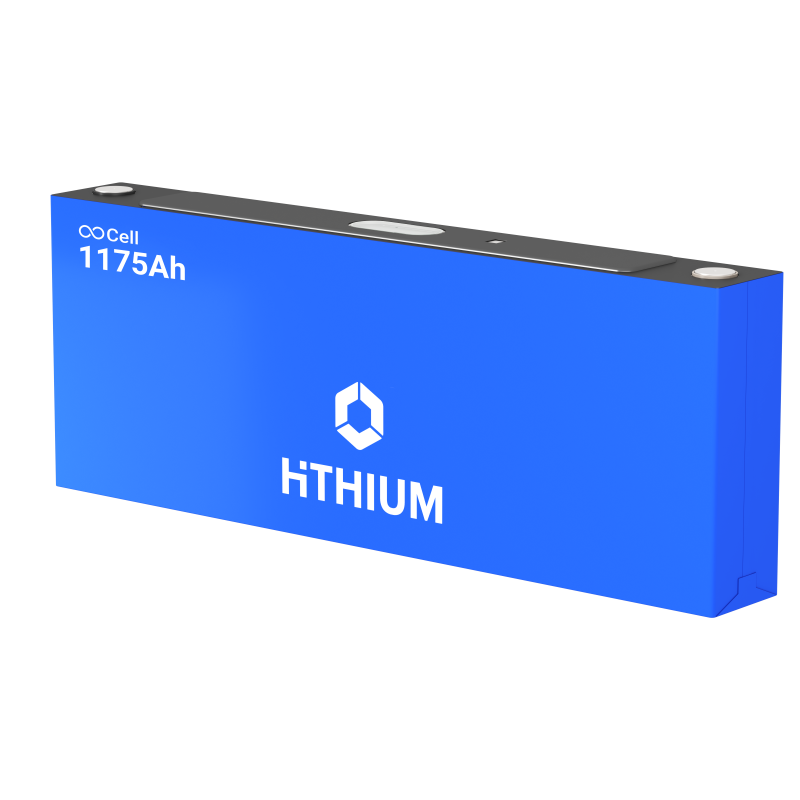
One of the most immediate benefits of adopting a hithium battery with higher per-cell capacity is the dramatic reduction in total cell count and electrical connections within a given system. When we look at a typical 6.25MWh energy storage system, using conventional smaller-format cells requires hundreds of individual units and thousands of interconnects—each representing a potential failure point. With the hithium 1175ah cell, however, the number of parallel-connected cells drops significantly. According to our product team, compared to previous 5MWh systems, the ∞Power 6.25MWh system using ∞Cell 1175Ah reduces connectors by more than 60%. Fewer connections mean fewer opportunities for loose contact, corrosion, or thermal issues. This streamlined architecture also cuts down on structural components, wiring harnesses, and electrical accessories, which directly translates into lower manufacturing costs and reduced on-site installation time.
Delivering a hithium battery of this magnitude requires overcoming substantial manufacturing challenges. When we began developing the hithium 1175ah, we knew that scaling up cell dimensions would demand breakthrough precision in every step of production. Our Chongqing manufacturing base implemented five key innovations to make this possible. Wide-width thick coating technology achieved a coating mass density COV of less than 0.2%, with online high-precision CCD inspection ensuring consistent quality. Large-electrode stacking reached 0.5mm alignment accuracy and 0.1625 seconds per sheet, increasing stacking throughput by 35% compared to conventional processes. Back-end cell manufacturing efficiency was boosted by 45% through high-efficiency baking and 1.2MPa high-pressure isostatic electrolyte filling. These precision gains are not internal metrics—they directly affect the reliability and cycle life that end customers experience.
Higher individual cell capacity does not mean higher risk when safety is engineered from the ground up. The hithium battery product family incorporates a multi-level safety architecture spanning the cell, pack, and system tiers. At the cell level, advanced electrolyte formulation forms high-temperature-resistant SEI and CEI layers, enhancing both cycle life and thermal stability. At the pack level, a dual-mode thermal protection structure prevents thermal propagation and oxygen ingress. At the battery management system (BMS) level, functional safety and cybersecurity are integrated via multimodal early warning algorithms and redundant control technologies. The hithium 1175ah has received UL 1973 and UL 9540A certifications from UL Solutions, confirming its compliance with global safety standards. For grid operators and project developers, this certification provides confidence that high-capacity storage can be deployed safely at scale.
From reducing electrical connections and simplifying system design to advancing manufacturing precision and embedding multi-layer safety, the hithium battery technology we have built around the hithium 1175ah cell offers a compelling path forward for large-scale energy storage. HiTHIUM Bess continues to refine this approach through the ∞Cell platform, ensuring that higher capacity goes hand in hand with lower lifecycle costs and greater operational reliability. When each cell does more, the entire system does better.




 Previous: