From utility-scale projects to commercial installations, the question we hear most often is simple: how do we get more value out of every kilowatt-hour? For us at HiTHIUM, the answer starts at the cell level. When you increase hithium battery capacity without compromising safety or cycle life, you change the economics of storage entirely. More energy stored in a single cell means fewer connections, lower system costs, and simpler operations over decades of daily use. That is why we have focused on building a portfolio of large-format cells—from 587Ah to 1175Ah to now 1300Ah—each designed to push efficiency higher while keeping what matters most: reliability and safety. Let us walk you through how high-capacity cells actually improve the way storage performs.
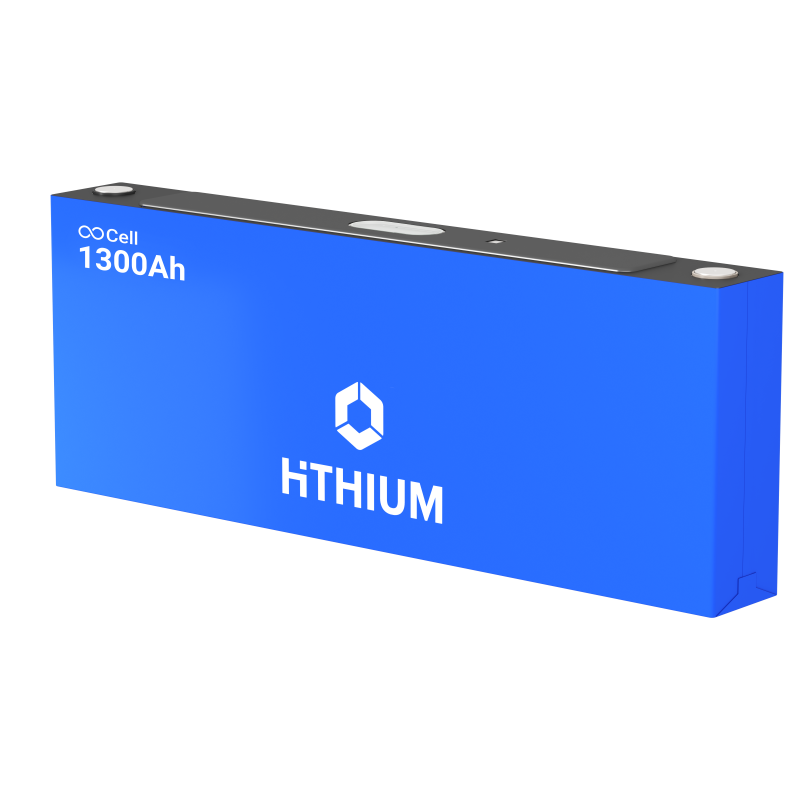
One of the clearest ways high-capacity cells drive efficiency is by reducing the number of components inside a system. A traditional setup using smaller cells requires thousands of individual connections, each one a potential point of failure. When we move to larger-format hithium cells, those connection points drop sharply. Take our ∞Cell 1300Ah 8h as an example. In a standard 20-foot container configuration, this cell reduces system connectors by more than thirty percent compared to conventional 2-hour cells. Fewer connections mean lower internal resistance and less energy loss during charging and discharging. For project owners, that translates directly into higher round-trip efficiency and fewer maintenance headaches over the system’s lifetime. And because hithium cells like the 1175Ah already operate at over 11,000 cycles, you get long-term reliability without sacrificing the energy density that makes large cells attractive in the first place.
A common concern with larger cells is whether safety can keep pace with capacity. We have addressed this from the ground up. Each hithium battery we produce incorporates a multi-level safety architecture that extends from the cell interior all the way to complete system-level protection. Our advanced electrolyte formulations form high-temperature-resistant SEI and CEI layers on electrode surfaces, which significantly reduces the risk of thermal runaway. We have also put these designs through rigorous validation. The ∞Cell 1175Ah, for instance, has passed large-scale fire tests within its 6.25MWh system configuration, demonstrating stable, controlled performance even under extreme conditions. This kind of validation matters because when you build a hithium battery into a multi-megawatt project, you need to know it will behave predictably through thousands of charge cycles, year after year, without unexpected thermal events.
High-capacity cells truly shine when the discharge window stretches beyond four hours. For 8-hour long-duration storage, conventional cells struggle with material degradation and ion movement limitations over extended cycling periods. That gap is exactly why we developed the ∞Cell 1300Ah 8h with ultra-thick electrode technology. In the ∞Power8 6.9MW/55.2MWh system built around this cell, the design enables deep 8-hour cycling with a service life exceeding 20 years. For grid operators and renewable developers, that level of performance unlocks new possibilities: smoothing solar generation across the evening peak, shifting wind power to morning demand, and ultimately driving levelized cost of storage down toward more competitive thresholds. When each hithium battery can carry more energy and last longer, the entire business case for long-duration storage gets stronger.
At HiTHIUM, we see high-capacity cells not as a trend, but as the natural evolution of smarter storage engineering. From the 587Ah cell with its energy efficiency and ultra-long cycle life, to the 1175Ah and 1300Ah cells built for demanding long-duration roles, each product in our ∞Cell family is designed with the same principle: bigger capacity should deliver better efficiency, not more complexity. That is the standard we hold ourselves to, and it is the standard your next project deserves.



 Previous: