For utility-scale solar projects, two systems may each store 6.25MWh yet deliver different results. Choosing the wrong BESS duration can leave the plant unable to meet its target output or cover the evening delivery window, putting planned electricity sales at risk.
Selecting between 2-hour and 4-hour configurations means matching solar generation with grid requirements and revenue opportunities. This article compares their operating profiles and explains how to choose the configuration that fits the project.
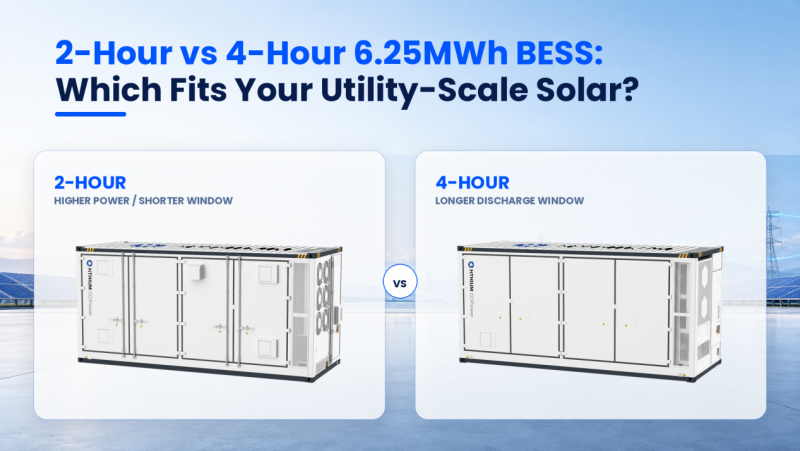
2-hour utility-scale battery storage focuses on delivering more power within a shorter operating window.
The battery captures midday PV surplus and stores it until solar generation declines. It then concentrates discharge into a shorter evening demand peak, supplementing the plant’s falling output.
For utility-scale solar projects, this schedule can bridge the mismatch between midday generation and a brief period of higher evening demand. Stored energy is allocated to the selected peak window, with discharge following the required delivery schedule.
With 6.25MWh of nominal capacity, a 2-hour configuration corresponds to approximately 3.125MW of nominal battery power. This higher-power profile concentrates energy delivery into a shorter period, making it suitable for brief events requiring a larger power contribution.
With appropriate equipment and controls, it can support short-duration peak shaving, PV output smoothing and ancillary services such as frequency regulation. The trade-off is faster energy depletion at higher output. Reducing discharge power can extend coverage while providing less power during the peak.
4-hour solar battery storage focuses on sustaining a lower output across a longer delivery window.
The battery captures daytime PV surplus and schedules discharge across the afternoon or evening as solar production declines. It spreads stored energy across several consecutive hours of demand, including periods after sunset.
For utility-scale solar projects, this schedule can bridge a longer mismatch between midday generation and later consumption. Charging with solar electricity that would otherwise be curtailed can also improve PV utilization when charging power and available storage capacity match the surplus.
With the same 6.25MWh nominal capacity, a 4-hour configuration corresponds to approximately 1.563MW of nominal battery power. This lower-power profile distributes energy delivery across a longer period, making it suitable for sustained afternoon or evening demand.
It can support sustained energy shifting and longer peak-shaving periods. The trade-off is a smaller power contribution from each container during any individual interval. Projects requiring both extended coverage and higher output may need additional battery containers and corresponding power conversion capacity.
HiTHIUM offers both configurations through its ∞Power product range, using 587Ah cells for the 2-hour system and 1175Ah cells for the 4-hour system.
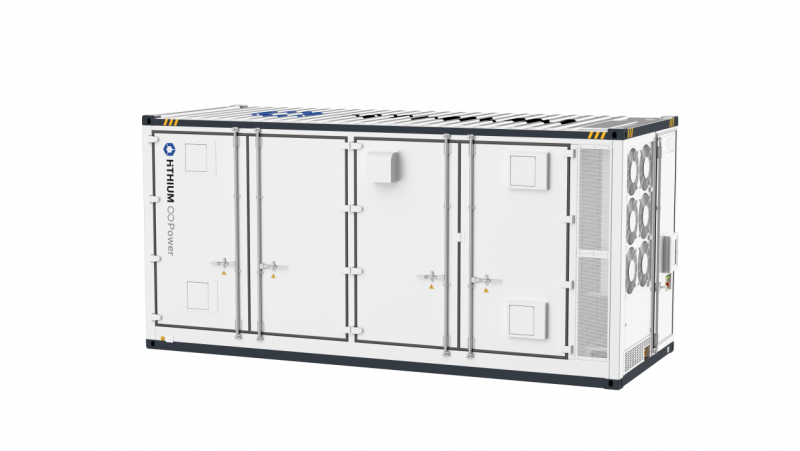
HiTHIUM ∞Power 6.25MWh 2h
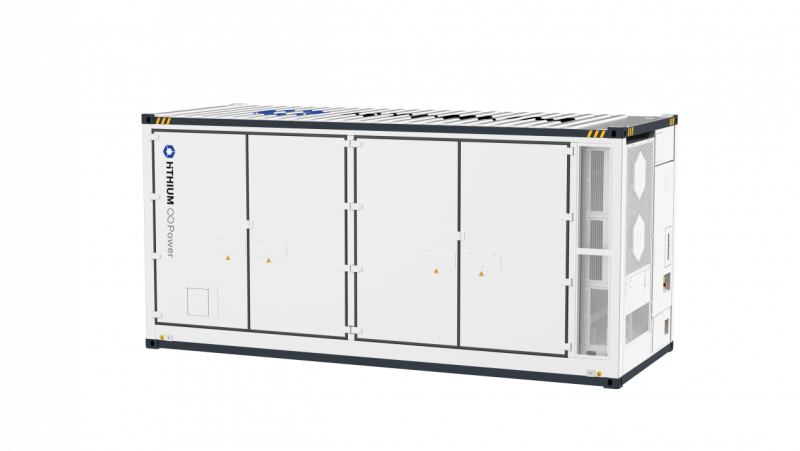
HiTHIUM ∞Power 6.25MWh 4h
For utility-scale solar developers, the comparison below applies their published ratings to utility-scale battery storage operating priorities.
Comparison | ∞Power 6.25MWh 2h | ∞Power 6.25MWh 4h |
Output power and duration | 0.5P; approximately 3.125MW for two nominal hours | 0.25P; approximately 1.563MW for four nominal hours |
PV energy shifting window | Concentrated delivery into a shorter evening peak | Distributed delivery across afternoon/evening demand |
PV utilization and curtailment | Higher charging power can capture brief, concentrated surplus | Lower charging power can suit longer, sustained surplus |
Revenue emphasis | Higher-power dispatch during short price peaks; ancillary services | Sustained energy sales across longer price or contracted delivery windows |
Cells and system configuration | 587Ah LFP; 8 × 1P416S; liquid cooling | 1175Ah LFP; 4 × 1P416S; liquid cooling |
Power figures are calculated nominal DC values; LFP means lithium iron phosphate.
The practical trade-off is charging and delivery intensity. The 2-hour configuration offers greater power for concentrated opportunities, while the 4-hour configuration spreads delivery across longer windows. For solar battery storage, this links the choice to both the surplus profile and evening revenue period.
For utility-scale solar developers, four checks establish the operating requirement.
Compare the PV surplus profile with the evening demand curve. Identify whether the required discharge is a narrow peak or a sustained energy deficit; the waiting time before discharge differs from discharge duration.
For utility-scale solar, calculate the required battery contribution after accounting for remaining PV output. Compare it with the export limit and available connection headroom during each delivery interval.
Compare selling the same stored energy within a short peak against spreading it across four hours. Later-hour prices and contracted delivery payments indicate whether extended coverage creates additional value.
Model whether available solar battery storage charging windows can replenish the BESS for planned dispatch. Both surplus power and total surplus energy matter, including seasonal changes.
Prioritize ∞Power 6.25MWh 2h when surplus must be captured quickly, the evening peak is short, and permitted export capacity supports higher output. This is the stronger candidate when revenue depends mainly on concentrated power delivery.
Prioritize ∞Power 6.25MWh 4h when daytime surplus supports a longer charging period, and the project earns value from sustained afternoon/evening delivery. This is the stronger candidate when a lower output must continue across several hours.
For utility-scale solar, 2-hour systems favor concentrated, higher-power delivery, while 4-hour systems favor sustained output. The right utility-scale battery storage configuration connects these capabilities with the project’s demand and revenue windows.
HiTHIUM’s ∞Power 6.25MWh 2h and 4h configurations offer both options. Discuss your generation profile and delivery targets with HiTHIUM to assess which better fits your project.
[1]International Energy Agency. Battery Storage Is Scaling Up and Taking on a Larger System Role.
https://www.iea.org/commentaries/battery-storage-is-scaling-up-and-taking-on-a-larger-system-role
[2]National Laboratory of the Rockies. 2025 Annual Technology Baseline: Utility-Scale PV-Plus-Battery.
https://atb.nlr.gov/electricity/2025/utility-scale_pv-plus-battery
[3]National Laboratory of the Rockies. Exploring the Future Energy Value of Long-Duration Energy Storage.
https://research-hub.nlr.gov/en/publications/exploring-the-future-energy-value-of-long-duration-energy-storage/