Industrial operations unfold on a timescale where seconds matter. A voltage sag lasting half a dozen cycles can scrap a batch of semiconductor wafers or send a CNC machining center into a fault state that takes hours to reset. We at HiTHIUM approach the challenge of industrial power stability not as a single problem to solve but as a layered condition that storage must address at multiple levels simultaneously. Grid disturbances originate from diverse sources: nearby faults, switching surges from heavy equipment, renewable intermittency, and the sheer variability of industrial loads themselves. Commercial energy storage systems positioned at the facility level intercept these disturbances before they propagate through sensitive production lines, creating a buffer zone between an unpredictable grid and processes that demand precision. Our work across sectors has demonstrated that storage is not merely backup in the traditional sense—it is active power conditioning that operates continuously, shaping the electrical environment within an industrial site rather than waiting for a failure to trigger a response.
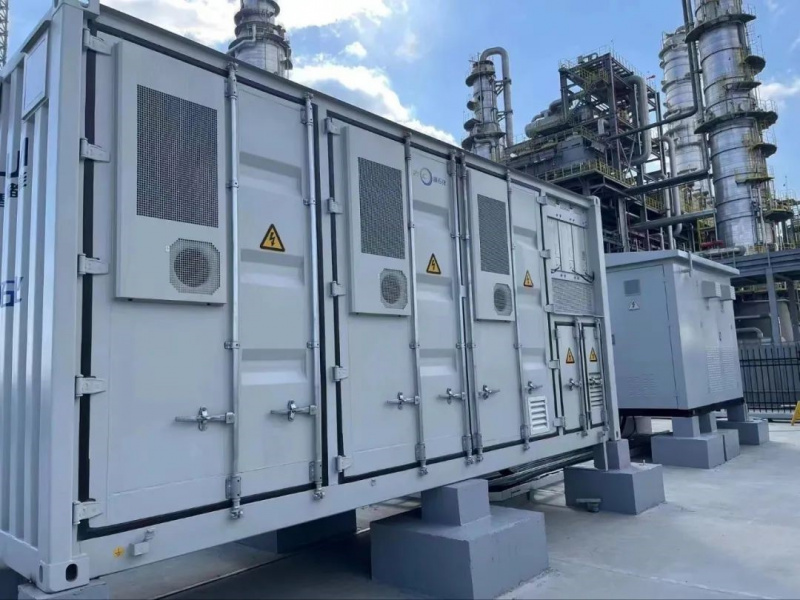
Manufacturing processes produce power demands that change abruptly. An electric arc furnace striking, a large motor starting across the line, or a stamping press engaging can draw current at rates that momentarily depress local voltage. Grid infrastructure responds to these surges through a hierarchy of slower mechanisms—tap changers on transformers, reactive power adjustments—that operate on timescales too long to prevent the initial disturbance. Industrial and commercial energy solutions built around battery storage bridge this gap through sub-cycle power injection. The power electronics within a storage cabinet sense the voltage deviation and deliver instantaneous active power to support the local bus, so the grid never sees the full magnitude of the transient. For facilities with high motor starting currents, this function alone can reduce nuisance tripping of protection relays and extend the service life of switchgear subjected to repeated electromechanical stress.
Many industrial sites operate at or near the thermal limit of their existing service transformers, yet upgrading to a larger unit represents a multi-month capital project involving utility coordination, civil works, and significant downtime. We have observed facilities where a few hours of afternoon peak load push transformer temperatures into ranges that trigger forced cooling or threaten insulation life. A storage unit discharging during those critical windows effectively flattens the net load profile, keeping transformer loading within rated boundaries without reducing actual production activity. The 261 kilowatt-hour liquid-cooled cabinet we deploy for these applications connects directly at the low-voltage distribution level, enabling the storage to serve local loads without requiring upstream infrastructure changes. This approach decouples industrial growth from the utility interconnection queue, allowing capacity expansion to proceed on the facility's own timeline.
Industrial sectors ranging from pharmaceuticals to food processing share a characteristic: once a batch begins, power interruption means total loss of the work in progress. Cleanup, restart, and requalification procedures can extend a two-second outage into days of non-productive time. Our commercial energy storage systems configured for backup operation maintain output continuity during grid-side events through an inverter architecture that transitions to island mode without the multi-second transfer gap associated with traditional generator starting. Beyond emergency support, this same capability enables scheduled load management—a facility can choose to island specific production lines during utility peak pricing windows, continuing operation entirely on stored energy while avoiding charges that can constitute the majority of a monthly electric bill. The multi-stage fire suppression integrated into each enclosure, which combines smoke and temperature monitoring with perfluorohexanone delivery, means this autonomous operation proceeds under safety supervision that does not depend on facility staff being present to detect an anomaly. An IP55-rated cabinet withstands the dust, coolant mist, and vibration common to factory environments, maintaining protection integrity across years of continuous deployment.
The electrical environment inside an industrial facility is shaped by the equipment operating within it and by disturbances arriving from the external grid. Storage positioned at the interface between these two domains gives facility operators a degree of control that passive distribution equipment cannot provide. By absorbing transients, shaving peak loads, and sustaining output through outages, our industrial and commercial energy solutions convert power stability from a condition subject to external forces into an engineered parameter that the facility itself governs. As manufacturing automation becomes more voltage-sensitive and as utility grids incorporate higher shares of variable renewable generation, this capability shifts from optional to infrastructure-essential.



 Previous: